Step-by-Step Guide to Mastering Drawing Basics in 2025
This site is reader-supported. When you buy through links on our site, we may earn an affiliate commission at no additional cost to you.
Unlock Your Inner Artist: A Journey Begins!
Are you ready to unlock your inner artist? This guide will lead you through essential steps to MASTER drawing basics by 2025. Whether you’re a beginner or seeking to refine your skills, these steps will EMPOWER your artistic journey and help you express your creativity with confidence!
What You’ll Need to Get Started
A sketchbook
Graphite pencils (various hardness)
Erasers (kneaded and regular)
Reference images (photos or printed material)
A willingness to practice regularly
An open mind to learn and experiment!
Best Seller
Ultimate Drawing Guide for Beginners
Perfect for aspiring artists
This comprehensive guide provides essential drawing techniques and tips for beginners, helping you build a solid foundation in the art of drawing.
Step 1: The Fundamental Shapes – Your Building Blocks
Everything Starts with a Circle and a Square!
Start by observing your surroundings and break down complex objects into basic shapes like circles, squares, and triangles. This foundational skill is crucial for any aspiring artist!
Practice the following:
Choose an object, like a vase, and identify its shapes: an oval for the top, a rectangle for the body, and a circle for the base.
Sketch these shapes lightly before refining your drawing. This step simplifies the process and helps you gain confidence.
Combine shapes: Draw a house with squares and triangles, adding dimension by rendering a cylinder for a chimney.
By mastering these fundamental shapes, you’ll see how they serve as the building blocks for any drawing, freeing you to create with ease and confidence!
Must-Have
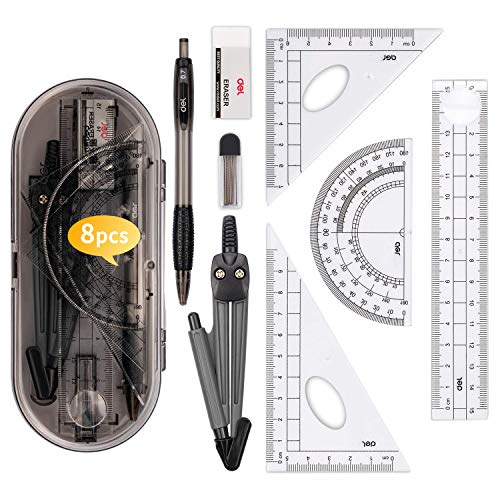
Complete 8-Piece Geometry Math Set
All essentials in one convenient kit
This 8-piece math set includes everything students need for geometry, making it a perfect school gift and essential tool for math classes.
Step 2: Understanding Proportions – The Secret Sauce
Why Size Matters in Drawing!
Master the concept of proportions to enhance your drawings. Accurate proportions ensure that your figures and scenes reflect reality, while distortions can undermine your artistic intentions.
Follow these steps to get started:
Use reference images: Look at photographs or real-life objects to grasp correct proportions. For example, when drawing a human figure, observe that the average adult is around eight heads tall.
Practice measuring: Hold a pencil at arm’s length to measure the height and width of different elements in your scene. This technique helps you visualize relationships between different parts.
Create a grid: Overlay a grid on your reference image and reproduce it in your sketch. This method will guide you in placing features accurately.
By incorporating these proportion strategies into your practice, you’ll breathe life into your art, creating more compelling and believable drawings!
Editor's Choice
Proportional Divider for Accurate Drawing
Achieve perfect proportions easily
This Proportional Divider helps artists and designers create accurate proportions in their work, making it an essential tool for any creative project.
Step 3: Shading Techniques – Bring Your Drawings to Life
Light and Shadow: The Dynamic Duo!
Explore the fascinating world of shading to add depth and dimension to your sketches! Effective shading transforms flat drawings into strikingly realistic images.
Utilize these techniques:
Hatching: Create parallel lines to render shadows. Experiment with varying line density—closer lines produce darker shadows. For instance, shade the left side of an apple using tight hatching for a rounded effect.
Cross-hatching: Layer sets of intersecting lines to intensify shadows. This technique works wonders for complex forms like a human face where shadows shift. Use lighter strokes initially, gradually building up.
Blending: Smoothly transition shades using a blending stump or your finger. This method is perfect for soft surfaces like skin or fabric. Try blending the shadows of a simple sphere to create a more three-dimensional look.
By incorporating these shading techniques, you’ll enhance your drawings, bringing them to life with light and shadow. Embrace the transformation of your art today!
Recommended
Shading Techniques Guide for Artists
Essential for teachers and students
This guide focuses on shading techniques, making it an invaluable resource for both art teachers and students to enhance their drawing skills.
Dive into experimentation to explore different artistic styles and techniques. Remember, drawing is not just a skill; it’s a personal journey that reflects who you are!
Try these actions to discover your unique voice:
Mix mediums: Experiment with pencils, inks, pastels, or digital tools. Each medium offers distinct textures and effects. For example, create a piece using watercolors for softness, then try bold markers for an entirely different flair.
Explore styles: Draw inspiration from different genres—realism, abstract, cartoon, or even surrealism. Create a series, trying a new style with each piece. You might find that combining elements from several styles creates something uniquely yours.
Reflect on your interests: Incorporate themes that resonate with you. Love nature? Create botanical drawings! Passionate about storytelling? Illustrate a scene from your favorite book.
By embracing experimentation, you’ll unlock new paths in your artistry, helping you to establish a style that is distinctly your own.
Best Value
36-Piece Professional Drawing Kit
Complete set for aspiring artists
This extensive drawing kit includes a variety of pencils and accessories, perfect for artists of all levels, and ideal for sketching on the go.
By mastering these drawing basics, you’re well on your way to becoming a skilled artist. Remember, practice and perseverance are key. Start your drawing adventure today! What will you create once you unleash your newfound skills and express your unique artistic vision?